By EL Kornegay Jr.
James Baldwin once wrote that what Beauford taught him to see first was not his painting, his art, “that came later,” but the world as Beauford “caused me to see it.”ii It is important that we understand Beauford the artisan so that we might understand his artistic genius and the deep beauty of his art.

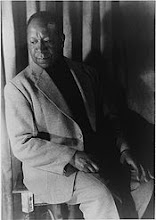
Portrait of Beauford Delaney
(ca. 1950)
Possibly by Gjon Mili
If we look at Beauford and his work through the lens that he taught Baldwin to use to view the world, then our initial glance frames him as an artisan who practiced first seeing and then painting. I would say his aim was not to produce fine art for us to regard from a distance, standing behind a velvet rope, while artificial light reflects the sophistication of the one viewing. Rather, Beauford the Artisan wanted to cause us to see something that we do not want to see. He wanted to teach us to see our world and to love even that which is considered the least of it.
It is at second glance that we see Beauford become an artist: a skilled practitioner whose life and work is just beginning to be recognized as “fine art.” His world went unnoticed by most; the darkness he made beautiful mattered only to him, and he remained faithful to what he saw.
It is my guess that this is the way for many who, like Beauford, practiced a craft on the margins where most do not dare to look or experience. They refuse to sacrifice the truth of what they see for the sake of acceptance – for the sake of what we perceive to be art.
Beauford Delaney becomes an artist only after we apprehend what he causes us to see – not before. He becomes an artist only after we have learned the practice of seeing the world – not merely its colors or its dimensions, but the spirit of the light shaping it in our eyes and minds. James Baldwin says of his mentor, “Beauford’s work leads the inner and the outer eye, directly and inexorable, to a new confrontation with reality.”iii

Portrait of James Baldwin
Beauford Delaney
(1945) Oil on canvas
Philadelphia Museum of Art
The artisan gives way to the artist only when we have accepted how he practices seeing the world and paints it. This is what makes Beauford Delaney an artisan who we are beginning to love as an artist and this is what makes his work fine art.
************
i This reflection is in response to the question of why I used “artisan” to describe Beauford Delaney. I am using James Baldwin as an interlocutor to frame this reflection, since it is he that first introduced me to Beauford as the one who taught him to see the world and to paint its beauty with his words. As such, I see myself as a student of both men.
ii James Baldwin, “On the Painter Beauford Delaney” in James Baldwin: Collected Essay, Toni Morrison, ed. (New York, N.Y.: Literary Classics of the United States, Inc., 1998), 721.
iii Ibid, pp.720.
In a previous posting entitled "Beauford Delaney: The Artisan as Witness," EL Kornegay Jr. took a first, insightful look at Beauford's art from the vantage point of his emerging awareness of Beauford's influence on James Baldwin. Here, he elaborates on what he sees as the difference between Beauford as "artist" and Beauford as "artisan."There may seem to be very little difference between the words “artist” and “artisan.” On the surface it is easy to see that the former proceeds from the latter. However, the application of these words can and does mean something different to the one labeling and the one being labeled. Such is the case with Beauford Delaney.i
James Baldwin once wrote that what Beauford taught him to see first was not his painting, his art, “that came later,” but the world as Beauford “caused me to see it.”ii It is important that we understand Beauford the artisan so that we might understand his artistic genius and the deep beauty of his art.

(ca. 1950)
Possibly by Gjon Mili
If we look at Beauford and his work through the lens that he taught Baldwin to use to view the world, then our initial glance frames him as an artisan who practiced first seeing and then painting. I would say his aim was not to produce fine art for us to regard from a distance, standing behind a velvet rope, while artificial light reflects the sophistication of the one viewing. Rather, Beauford the Artisan wanted to cause us to see something that we do not want to see. He wanted to teach us to see our world and to love even that which is considered the least of it.
It is at second glance that we see Beauford become an artist: a skilled practitioner whose life and work is just beginning to be recognized as “fine art.” His world went unnoticed by most; the darkness he made beautiful mattered only to him, and he remained faithful to what he saw.
It is my guess that this is the way for many who, like Beauford, practiced a craft on the margins where most do not dare to look or experience. They refuse to sacrifice the truth of what they see for the sake of acceptance – for the sake of what we perceive to be art.
Beauford Delaney becomes an artist only after we apprehend what he causes us to see – not before. He becomes an artist only after we have learned the practice of seeing the world – not merely its colors or its dimensions, but the spirit of the light shaping it in our eyes and minds. James Baldwin says of his mentor, “Beauford’s work leads the inner and the outer eye, directly and inexorable, to a new confrontation with reality.”iii

Beauford Delaney
(1945) Oil on canvas
Philadelphia Museum of Art
The artisan gives way to the artist only when we have accepted how he practices seeing the world and paints it. This is what makes Beauford Delaney an artisan who we are beginning to love as an artist and this is what makes his work fine art.
i This reflection is in response to the question of why I used “artisan” to describe Beauford Delaney. I am using James Baldwin as an interlocutor to frame this reflection, since it is he that first introduced me to Beauford as the one who taught him to see the world and to paint its beauty with his words. As such, I see myself as a student of both men.
ii James Baldwin, “On the Painter Beauford Delaney” in James Baldwin: Collected Essay, Toni Morrison, ed. (New York, N.Y.: Literary Classics of the United States, Inc., 1998), 721.
iii Ibid, pp.720.