Les Amis de Beauford Delaney is supporting the completion of

BEAUFORD DELANEY: SO SPLENDID A JOURNEY,

the first full-length documentary about Beauford.


Join us in making this video tribute to Beauford a reality!

TO MAKE A TAX DEDUCTIBLE DONATION,

CLICK HERE.


Saturday, April 16, 2011

Beauford at the Art Miami Basel Festival


Laurence Choko, proprietor of the Galerie Intemporel in Paris, displayed the Beauford Delaney painting entitled Portrait de Vasilli Pikoula during her Ten is One exposition at the Art Miami Basel Festival in December 2010.


Works by Arturo Montoto and Beauford Delaney
Exposition Ten is One , Art Basel Miami Festival 2010
Photo courtesy of Galerie Intemporel


Choko has the following to say about Beauford’s work, and about this portrait (shown at the right in the photo above) in particular:

I love the expressionist aspect of Beauford Delaney’s figurative works. The subjects of his portraits often express great emotion, and their vulnerability brings them alive for me.

What I admire in the Portrait de Vasilli Pikoula, which I included in the Ten is One exposition from the Art Basel Miami Festival last December, is the generosity with which he represented his painter friend (Pikoula was a Greek painter). In this portrait, Delaney gives her an aristocratic air – it reminds me of the dignified, old women of the Antilles who carried themselves well regardless of their social position.

Saturday, April 9, 2011

Beauford and Larry Calcagno

An Artistic Friendship: Beauford Delaney and Lawrence Calcagno
Catalog cover for art exposition
Palmer Museum of Art (2001)


Larry Calcagno was one of Beauford’s closest friends. They met in Paris through their mutual friend Charley Boggs. Beauford and Calcagno were both artists, both gay men, and both deeply philosophical. Beauford’s biographer, David A. Leeming, describes their relationship as “intellectually intense, but for the most part physically platonic.”

Calcagno had a studio on rue Vercingétorix, the street where Beauford’s patron Mme du Closel would later purchase a studio for Beauford. Beauford spent a great deal of time there before Calcagno returned to the United States. Calcagno gave Beauford several canvases, paper for watercolor paintings, and paints prior to his departure.

See a letter written by Beauford to Calcagno, dated December 1953, below.


Letter from Beauford to Larry Calcagno, December 1953
Images: Archives of American Art, Smithsonian Instititution


The two men would correspond regularly for many years, with Beauford frequently confiding his emotional difficulties to Calcagno in his writings.

Calcagno returned to Europe in 1955, and invited Beauford to accompany him on the first of several trips that they would take together. He and Beauford traveled to Madrid for Calcagno’s art exposition at the Gallery Clan. Calcagno was able to convince the gallery to mount a show for Beauford in June 1955. It was Beauford’s first solo exposition in Europe, and it was a commercial success. In 1956, Calcagno and Beauford visited Ibiza, Spain, where they met up with James Baldwin and other friends. Calcagno, Darthea Speyer, and Charley Boggs took Beauford on a trip to Venice in 1966, where they attended the Bienniale exposition.

Larry Calcagno, Beauford, and Charley Boggs in Venice
Photo from Amazing Grace: A Life of Beauford Delaney (1998)


Calcagno would frequently send Beauford money with his letters – money that Beauford often desperately needed. When Beauford required hospitalization after his 1961 suicide attempt, Calcagno contributed money to pay for Beauford’s care and came to Paris to visit Beauford during this difficult time. In the spring of 1975, he interrupted his European travels to come to Paris to search for Beauford, who had disappeared. Calcagno wrote of this episode, saying:
He disappeared a couple of times. This time he can’t seem to be located. We called and looked in all the places where one might want to disappear to—I know a lot of them. He must still be alive, his body would have shown up. He has just simply dissolved himself to escape the final cruelty of the world. I weep for him and I bless him!
Beauford was eventually found. He was committed to Sainte-Anne’s Hospital soon thereafter.

The relationship between Beauford and Larry Calcagno can be summarized in a single phrase that Beauford wrote in a letter to Calcagno in 1968, in which he described a “deathless kinship that is constant [and] is always alive and close between us.”

Saturday, April 2, 2011

More on Beauford's Last Studio - Rue Vercingétorix

You may recall that I published a posting about Beauford's last studio, which was located at 53, rue Vercingétorix in Paris' 14th arrondissement, last year. (Click here to see photos of the neighborhood in its current state as well as photos of the interior of the studio and Beauford and Henry Miller in the courtyard outside.)

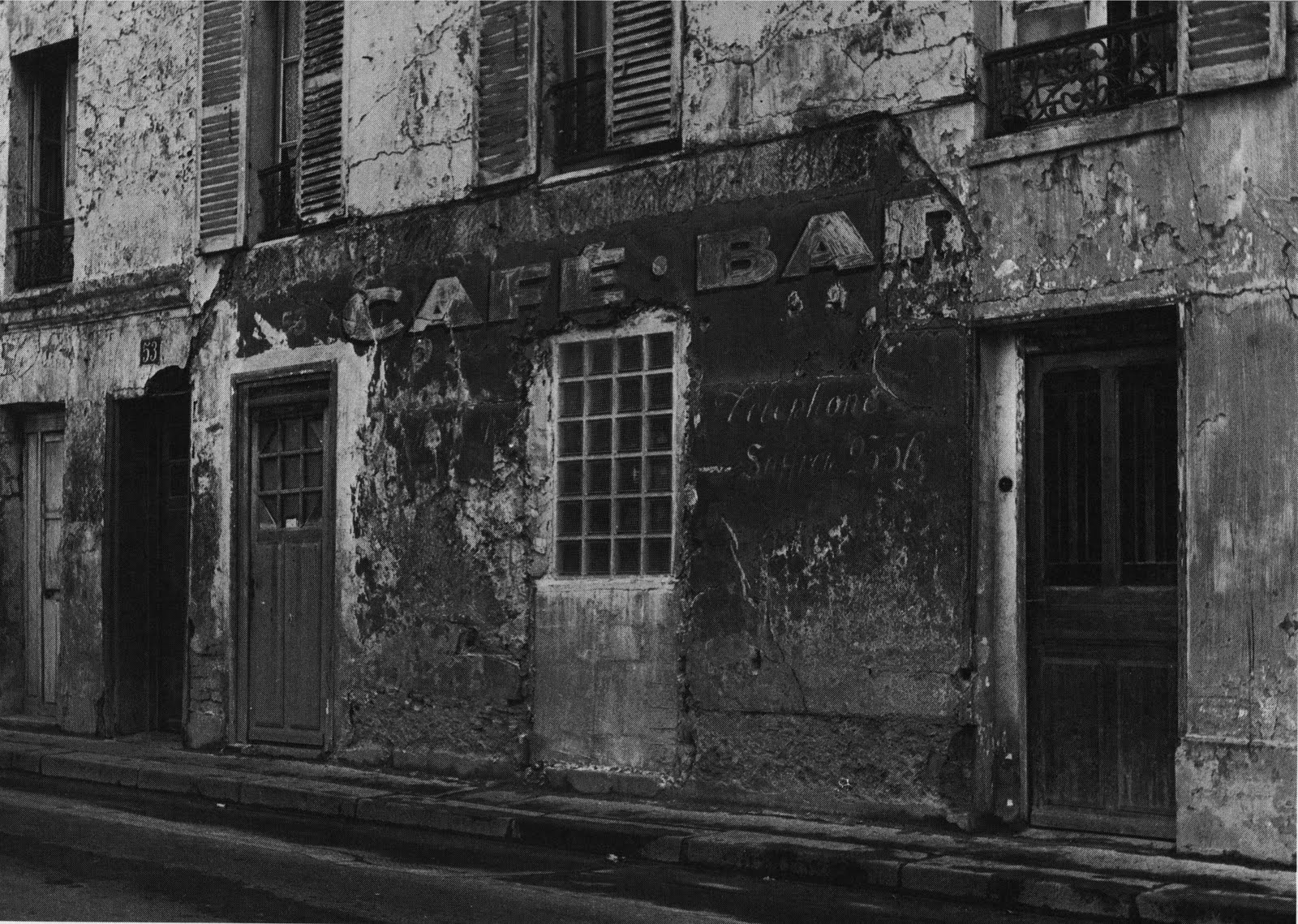
I have finally found a photo of the façade of the building that was located at this address!

53, rue Vercingétorix
Photo by Nicholas Breach
The Streets of Paris by Richard Cobb (1980) Pantheon Books


According to Beauford's dear friend Burt Reinfrank, Beauford's studio overlooked a schoolyard. The photo below may represent that same schoolyard.

Abandoned School, rue Vercingétorix
Photo by Nicholas Breach
The Streets of Paris by Richard Cobb (1980) Pantheon Books


Rue Vercingétorix was part of what used to be known as the quartier de Gergovie, which was originally settled by immigrants from Brittany. The photos shown above were taken during the 1970s, at a time when the neighborhood was in steep decline. This was the state of affairs during Beauford's last years there.

Saturday, March 26, 2011

Galerie Darthea Speyer Records Go to the Smithsonian

In commemoration of the 32nd anniversary of Beauford's death, I am pleased to reopen the Les Amis de Beauford Delaney blog with a wonderful guest posting that has been contributed by Jason Stieber of the Smithsonian Institution's Archives of American Art. All images below have been provided by the Smithsonian.
**********

When Beauford Delaney arrived in Paris in 1953, his circumstances were hardly more comfortable than when he left New York City. Accustomed as he was to living near the precipice of destitution, Delaney made the best of his situation. He immediately established himself within a large circle of expatriate artists and writers. Most notably, he reconnected with James Baldwin, whom he had met in New York City in the 1940s. Beauford’s kindness and affable nature inspired uncommon devotion in those closest to him.

One of his most ardent admirers was the American cultural ambassador and art dealer Darthea Speyer. Speyer exhibited Beauford’s work in her Paris gallery and, from the moment of their meeting until her death in 2010, employed her considerable executive skills to advance the cause of his life and work. The Smithsonian’s Archives of American Art in Washington, DC recently acquired the records of the Galerie Darthea Speyer as a gift from the dealer’s estate. These records are a rich trove of information on the network of friends who supported Beauford and whose loyalty proved vital in the dark years near the end of his life. While there are no letters from the artist himself, the collection contains correspondence to Speyer from Romare Bearden, Herbert Gentry, Ahmed Bioud, James Jones, and Bernard Hassell.

 Darthea Speyer letter to Romare Bearden, 1974

In 1973, Speyer mounted a solo exhibition of Beauford’s work. The collection contains numerous photographs from the opening of this exhibition as well as documents pertaining to its organization and the sale of artwork. Jazz musician and composer Ornette Coleman made an appearance on opening night, as did one of Beauford’s most generous benefactors, Mme. de Closel, who provided him with a free flat on rue Vercingetorix during the last decade of his life.

 Ornette Coleman (far left) and Beauford (middle left) at the 1973 exposition

Beauford and Darthea Speyer (middle right) stand before Beauford's portrait of Speyer

Unfortunately, Beauford experienced a dramatic decline in his physical and mental health during the mid-1970s. Letters in the collection document the care his worried friends took with his various arrangements, hospitalizations, and disappearances. They also demonstrate their unflagging devotion to getting his work exhibited internationally. A series of letters between Speyer and Romare Bearden in 1974 trace the birth of an idea to mount a full retrospective of Beauford’s work at the Studio Museum in Harlem, an exhibition that was finally made manifest in 1978, a year before his death. Even after Beauford’s death, Speyer continued to campaign for her friend. Letters organizing and promoting the sale and exhibition of his work date all the way to the gallery’s close in 2009.


 Letter from Romare Bearden to Darthea Speyer

The Galerie Darthea Speyer records are an invaluable primary resource for the study of Beauford’s life. The Archives of American Art is proud to have added these records to our research holdings so that generations of scholars may continue to encounter Beauford’s remarkable spirit. Other collections at the Archives of American Art relating to Beauford and his circle include:

Oral history interview with Darthea Speyer
http://www.aaa.si.edu/collections/interviews/oral-history-interview-darthea-speyer-11786

The Joseph Delaney papers
http://www.aaa.si.edu/collections/joseph-delaney-papers-7477

The Romare Bearden papers
http://www.aaa.si.edu/collections/romare-bearden-papers-5881

The Lawrence Calcagno papers
http://www.aaa.si.edu/collections/lawrence-calcagno-papers-9238

The Roko Gallery records
http://www.aaa.si.edu/collections/roko-gallery-records-7249/more

The Adelyn Breeskin papers
http://www.aaa.si.edu/collections/adelyn-dohme-breeskin-papers-8422

The Al Hirschfeld papers
http://www.aaa.si.edu/collections/al-hirschfeld-papers-7079/more

Oral history interview with Herbert Gentry
http://www.aaa.si.edu/collections/interviews/oral-history-interview-herbert-gentry-11493

The Adeline Herder papers
http://www.aaa.si.edu/collections/adeline-herder-papers-6323/more

For more information on the above mentioned Smithsonian archives, contact:

Jason Stieber
Collections Specialist
Archives of American Art
Smithsonian Institution
(202) 633-7958