David Byrne - award-winning musician, writer, visual artist, and filmmaker - performed his David Byrne - Who Is The Sky? concert yesterday at the Big Ears Festival in Beauford's home town of Knoxville, TN.

Photo credit: Shervin Lainez
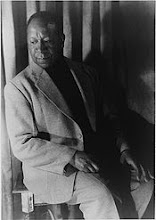
Byrne is featuring Beauford in his upcoming book, Sleeping Beauties, which is all about brilliant ideas that got overlooked or forgotten but can be / are being revived.
He found Beauford’s renaissance over the last 10 years to be a "sleeping beauty," and he reached out to Les Amis to set up a fact checking call for the chapter he is writing about Beauford's rediscovery.
Byrne experienced Beauford's work for the first time when he visited the Be Your Wonderful Self: The Portraits of Beauford Delaney exhibition at the Michael Rosenfeld Gallery in NYC. He told me that he and his wife went to the show because it had "gotten a nice review in the Times."

Catalog cover
Artwork © Estate of Beauford Delaney,
by permission of Derek L. Spratley, Esquire,
Court Appointed Administrator
Courtesy of the Michael Rosenfeld Gallery, LLC, New York, NY
The magnificence of Beauford's paintings notwithstanding, Byrne and his wife were greatly impressed with his writing, which they discovered in a display of correspondence that had been included in the show. (One of the vitrines was filled with handwritten letters to Larry Calcagno, Al Hirshfeld, Palmer and Miriam Hayden, and other friends and acquaintances.)

Be Your Wonderful Self: The Portraits of Beauford Delaney
(September 8–December 23, 2021)
at Michael Rosenfeld Gallery, New York, NY
Artworks © Estate of Beauford Delaney,
by permission of Derek L. Spratley, Esquire,
Court Appointed Administrator,
Courtesy of Michael Rosenfeld Gallery LLC, New York, NY

Be Your Wonderful Self: The Portraits of Beauford Delaney
(September 8–December 23, 2021)
at Michael Rosenfeld Gallery, New York, NY
Artworks © Estate of Beauford Delaney,
by permission of Derek L. Spratley, Esquire,
Court Appointed Administrator,
Courtesy of Michael Rosenfeld Gallery LLC, New York, NY

Be Your Wonderful Self: The Portraits of Beauford Delaney
(September 8–December 23, 2021)
at Michael Rosenfeld Gallery, New York, NY
Artworks © Estate of Beauford Delaney,
by permission of Derek L. Spratley, Esquire,
Court Appointed Administrator,
Courtesy of Michael Rosenfeld Gallery LLC, New York, NY
They subsequently saw Be Your Wonderful Self at the Ogden Museum of Southern Art in New Orleans. Byrne told me, "By then we realized - oh, he's back."
During a second call, I spoke to Byrne at length about Beauford and Sleeping Beauties. He reiterated how impressed he and his wife were by Beauford's writing, saying that many visual artists are challenged when it comes to expressing themselves in writing. He said that after visiting the exhibition at Ogden, he began seeing more references about Beauford.
I mentioned that one of the essays in the catalog for the Resonance of Form and Vibration of Color exhibition that the Wells International Foundation organized in Paris in 2016 is all about Beauford's writing and noted that this exhibition is credited by some as being the beginning of Beauford's renaissance.*
Our conversation turned to the reason Byrne is including Beauford in Sleeping Beauties. He said that after seeing Beauford's work at Ogden, he asked himself "How in the world did this go missing?" and "How did it get rediscovered?" His search for the response to that question brought him to Les Amis and to me.
Byrne talked about how the people of Knoxville had known so little about Beauford before Resonance of Form, and I told him about the "Knoxville 11," the eleven people from Knoxville who came to Paris to see the show. I also told him that the September 2016 article the NYTimes published about Beauford was a direct result of the Paris exhibition.
Sleeping Beauties is a work in progress, and Byrne said that he may reach out for additional information as he finishes up his writing.
As soon as the book is published, Les Amis will read the chapter about Beauford and post a review!
*Resonance of Form was part of a much larger, multi-layered tapestry of scholarship and advocacy that has specifically helped anchor his brilliance in his hometown of Knoxville, Tennessee. One of the most significant contributions to 2016 catalog for the show was Levi Prombaum’s essay, "Reading Beauford Delaney’s Words and Letters: Three Thoughts." By meticulously exploring Delaney’s literacy and intellectual life, Prombaum shifted the focus away from a reductive "struggling artist" persona, reframing him instead as a master of both the brush and the pen whose prose was as "vibrating" as his abstractions.
The renewed appreciation for Delaney’s genius is the result of a massive, collective effort involving decades of work from numerous scholars and academics. The intellectual groundwork was laid by foundational figures like David Leeming, whose definitive biography remains a touchstone, and Richard J. Powell, whose rigorous art historical analysis elevated Delaney’s profile within the canon of Modernism. Deep critical analysis from scholars such as Mary Campbell, Adrienne L. Childs, and Monika Gehlawat has provided the essential lenses through which we now view Delaney’s transition from portraiture into his transcendent yellow abstractions.
The cultural and literary context of Delaney’s life has been further enriched by the insightful perspectives of Hilton Als, Rachel Cohen, and Amy Elias, who have bridged the gap between his visual output and his profound connections to the 20th-century literary world. This scholarly movement has been bolstered by the institutional stewardship of the Smithsonian American Art Museum and the Knoxville Museum of Art, where Stephen Wicks has been a pivotal force in celebrating Delaney’s legacy on a local level. Together, these voices have ensured that Delaney is recognized not just as a figure of the past, but as a central player in International Modernism.
Much of the specific historical detail and research that allows for such a deep understanding of Delaney’s career today is owed to the tireless, decades-long service of Michael Rosenfeld and halley k harrisburg of the Michael Rosenfeld Gallery. Their unwavering commitment to Delaney’s oeuvre and their willingness to share their extensive archives have been essential to the recovery effort. Through their work and the combined efforts of the academic community, the "vibration of color" that Delaney captured on canvas continues to resonate from the galleries of Paris to the streets of Knoxville.