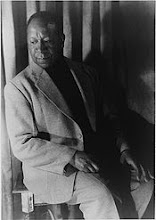
Les Amis de Beauford Delaney is supporting the completion of

BEAUFORD DELANEY: SO SPLENDID A JOURNEY,

the first full-length documentary about Beauford.


Join us in making this video tribute to Beauford a reality!

TO MAKE A TAX DEDUCTIBLE DONATION,

CLICK HERE.


Saturday, August 20, 2011

Beauford's Portraits of James Baldwin - Part 2

Last week, Dr. Catherine St. John commented on two of Beauford's portraits of James Baldwin. both of which are in private collections. Today, I present images of two Baldwin portraits that belong to major museums and one from a private collection that traveled the U.S. in a major exposition of Beauford's works, along with excerpts from descriptions that the museums present(ed) with these works. I invite you to compare and contrast these portraits, including the ones discussed last week, and submit a comment about which one(s) you appreciate most.

*************

The portrait owned by the Philadelphia Museum of Art is part of the museum's permanent collection, but it is not currently on view. The label for the painting reads:
This iconic painting is a very early depiction of the famous writer and civil rights activist James Baldwin, who was twenty-one when Delaney created this portrait. Closely cropped and vibrantly painted, it jumps out from the canvas, presenting an up-close encounter with the sitter. As in Delaney's self-portraits, he painted one eye slightly different from the other, a pictorial device also found in Pablo Picasso's paintings. Of the many portraits Delaney made of Baldwin, this one is among his most direct and expressive.

Portrait of James Baldwin
(1945) Oil on canvas
Philadelphia Museum of Art


The National Portrait Gallery of the Smithsonian Institute owns the portrait shown below. Part of its description of the painting reads as follows:
Although Delaney loved Baldwin, his portrait is not about nostalgic affection. Heated and confrontational, its harsh colors roughly applied, the pastel hints at the inner anxieties that would ultimately land Delaney in a psychiatric hospital. His pastel glows with the vibrant, Van Gogh–inspired yellow the artist often used after he moved to Paris in the 1950s. One of perhaps a dozen portraits that Delaney made of Baldwin over thirty years, it is both a likeness based on memory and a study of light.

James Baldwin
(1963) Pastel on Paper
National Portrait Gallery, Smithsonian Institute


The Sage Black was a key oeuvre shown at the exposition mounted by the Minneapolis Institute of Arts in 2004-2005. The museum's description of this remarkable painting mentions Beauford's technique as well as comments on his choice of colors:
Delaney superimposed a calligraphic outline on an abstract composition of reds, greens, yellows, and blues. Filled with all the colors of a flame, this incendiary, combustible background peers through Baldwin's form, conveying the passion and fire that was such an integral part of the author who penned, just a few years before, the foreboding essay titled The Fire Next Time.

The Sage Black
(1967) Oil on canvas
Private collection
Image from Artsmia Web site

Of the portraits displayed last week and the ones shown above, I personally favor the 1963 portrait (shown above) because it makes Baldwin look youthful and accessible. Which do you prefer? Leave your comments in the space below!

Saturday, August 13, 2011

Beauford's Portraits of James Baldwin - Part 1

I recently received a letter from Dr. Catherine St. John, Doctor of Arts, Professor of Humanities and Social Sciences at Berkeley College in New Jersey, and long time supporter of Les Amis de Beauford Delaney. In it, she states:
Beauford Delaney’s life-spanning friendship with James Baldwin is well known. A rewarding topic of focus for me is the dozen or so portraits he did of Baldwin, his muse. They give us unique glimpses into specific moments in Delaney’s art making practice but, even more, the incontestable truth of how we construct identity, how we make it visible and how we experience a sense of belonging.

Dr. St. John also mentions how Beauford's subjects are often painted in strikingly different colors.

Dr. Catherine St. John at
Beauford's Gravesite Ceremony - October 2010
© Discover Paris!


In reading this letter, I was reminded of how many portraits Beauford painted of James Baldwin, how colorful they are, and how different they are from each other. Dr. St. John graciously consented to comment on two of them - Dark Rapture (1941) and a 1965 portrait of Baldwin - and to share further thoughts on Beauford's work.

About these portraits, Dr. St. John states:

Both portraits, Dark Rapture (James Baldwin), 1941, oil on canvas or board, 34 x 28 inches, and James Baldwin, 1965, oil on canvas, 30 x 21 inches, are modest in dimensions. Both paintings are signed and dated. Their intimate scales draw us more closely to the virtuosity of Delaney’s painterly touch. They are created with straightforward media and give viewers an immediate sense of the paintings as physical objects.

Dark Rapture
(1941) Oil on canvas
Private collection


Portrait of James Baldwin*
(1965) Oil on canvas
Private collection


Dark Rapture is an especially dynamic and luminous painting that shows Beauford Delaney’s preferred palette, a range of colors and white chosen for symbolic, emotional and aesthetic reasons. It is the first portrait that Beauford Delaney did of James Baldwin and it marks a new and original approach to the male nude, a subject generally less frequently addressed by artists.

It is a composition that combines gesture and chromatic intensity with the silhouette of Baldwin, one side in shadow lit from the right, against a background of light emanating from color. It is a deeply affecting work, one of a number of portraits that Delaney created of his muse. Pieced together, they record the personal journeys of two great artists and form a collective field of memory.

While the 1965 portrait of James Baldwin, completed decades later, is not nearly as explosive as Dark Rapture, it is charged with human presence. The isolated, self-contained image of Baldwin is the special intersection of the world of light and the subjective consciousness that Beauford Delaney brought to his portraits. It is a supremely expressive portrait in which the eyes, the most intimate and powerful feature of the face, act like magnets, bringing us close to the mind, soul and emotions of a great writer who finds his place in history through his literature as well as the unique visual language of his mentor, Beauford Delaney.

Beauford Delaney worked with the materiality of paint with color and texture applied in an abstract gestural style, filling the entire pictorial space. His tactile surfaces of brilliant colors are prime carriers of light and space and it is in his use of yellow - ochre, cadmium, lemon - that we discover the substance of light in relation to spirit. It is the concreteness of his color rather than its illusionistic potential that is the essence of Delaney’s art.


*Beauford's 1965 portrait of Baldwin was shown at the Studio Museum in Harlem in 1978 during the first retrospective of his work. It is Number 18 in the catalog of the show, and is simply listed as Portrait of James Baldwin. The provenance is shown as "Private Collection of Beauford Delaney: Paris."


Saturday, August 6, 2011

Bob Shigeo Remembers Beauford

Bob Shigeo is an American artist and WWII veteran who has lived in Paris since 1953. Inspired by the kinetic art of Alexander Calder and the paintings of Jackson Pollack, he took advantage of the GI bill to study at the Escuela Nacional de Pintura y Escultura in Mexico, the Art Students’ League in New York, and finally the Ecole de la Grande Chaumière in Paris.

Bob Shigeo at the reception following
the gravesite ceremony in October 2010
© Discover Paris!

Bob’s memory of meeting Beauford is intricately tied to Beauford’s friend Earl Kirkham. (Kirkham was the New York painter that Beauford happened to run into at the Dôme café on his first night in Paris.)

According to Bob, Kirkham was well-known and respected among the American artists in Paris. He taught at the Académie Colarossi, sister school to the Académie de la Grande Chaumière located two doors down the street, where Bob was enrolled. Bob met Beauford either at the Académie Colarossi or the adjacent Wadja Restaurant, but he does not recall the details. Wadja was a very modestly priced restaurant during the 1950s and served as the “headquarters” for those studying at the Grand Chaumière and the Colarossi. Beauford lived nearby at the Hôtel des Ecoles and was always in search of a low-cost meal, so it is likely that the two men met there.

Wadja Restaurant
© Discover Paris!

Though Bob now knows that Beauford was no more than 52 years old when they first met, at the time, he thought that Beauford was around 80 years of age! He thought the same thing about Kirkham, and attributes this to the fact that both men had a certain reputation in the New York art world. He did not know that Beauford and Kirkham had known each other prior to coming to Paris, and said that he found both men to be unpretentious and approachable, despite their “stature.”

Bob visited Beauford many times in Beauford’s studios at the Hôtel des Ecoles and at rue Vercingétorix. He recalls the latter studio being about twice the size of the former, but says that the two places had one special thing in common – the color white. At the Hôtel des Ecoles studio, the walls were covered with traditional French wallpaper (which generally had a busy, colorful pattern). Bob remembers that Beauford covered the walls with white paper so as “not to be distracted” by the walls when he worked. Similarly, at rue Vercingétorix, Bob recalls that Beauford draped everything in the apartment that he could with white sheets.

Bob’s fondest memories of Beauford are at rue Vercingétorix, where he would often stop by on his way home between 5 PM and 7 PM. He said that Beauford was a good cook and he would often prepare a meal that he and Bob would share. Bob noted that though Beauford liked wine, he would never serve wine with these meals.

Beauford had a nice chair in his studio and an easel set up nearby. Bob recalls that Beauford would invite him to sit down and then immediately go over to the easel and begin to sketch or paint him. He always thought it was interesting that Beauford would never ask permission to paint him – he’d just begin working. He painted Bob several times without asking! Unfortunately, the whereabouts of these portraits are unknown.

Once, Bob sat for a portrait in a black pullover one time, but when he saw it, he found that Beauford had painted the pullover in red. Bob indicated that he recognized this as an example of a very important aspect of Beauford’s artistic persona – he said that Beauford did not feel the need to paint “reality” – to copy exactly the forms and colors in front of him. He painted what he “felt,” which is what made him the important artist that he was.

Saturday, July 30, 2011

Joseph Delaney Remembers Beauford

Joseph Delaney was Beauford’s younger brother. Born in 1904, he and Beauford were the closest in age of the Delaney siblings. Both became artists and were part of a community of artists living in NYC during the Great Depression. Both have their works exhibited at the Knoxville Museum of Art in their hometown of Knoxville, Tennessee.

Image of a portrait of Joseph Delaney
by Beauford Delaney
in Amazing Grace: A Life of Beauford Delaney
by David A. Leeming

Joseph was asked to contribute remarks to the catalog that was published in conjunction with the first retrospective of Beauford’s work, held at the Studio Museum in Harlem in 1978. He described Beauford as “one of the most sensitive and talented of all artists of all times,” and said that if he were to qualify that statement, he would need to explore “all of the qualities which make for the enigma which genius is . . .” He noted that Beauford was recognized early in life as being a special person with unique talents, and that “teachers and other professional people of high rank gave Beauford time and understanding.”

Catalog for Beauford’s 1st Retrospective at the
Studio Museum in Harlem 1978

Joseph also described Beauford as being multitalented, saying that Beauford could “sing like mad,” and play the ukulele, and that he was an excellent mimic. Beauford was the extrovert, while Joseph was the introvert of the two brothers.

Another distinction that Joseph makes in his tribute to his brother is that Beauford developed an appreciation for opera and “other great classics in music and literature.” He states that Beauford was never happier than on the day in 1969 when Joseph visited him in Paris and Beauford took him to the opera.

To read the complete text of Joseph Delaney’s remarks, click on the following link: http://sunsite.utk.edu/delaney/beauford.htm